

We are living in an ever changing digital world that moves at an ever-increasing speed, all these changes present new technical issues which may impact the workflow, users and marketing. One such term that’s recently started appearing in forums, logs, and support tickets is “fix huzoxhu4.f6q5 3d bug.”
For website owners, SaaS marketers, and tech‑savvy users, encountering a string like huzoxhu4.f6q5‑3d can feel confusing and even alarming. That’s why this guide is designed to unpack everything you need to know about this bug, from what it actually means to step‑by‑step fixes and long‑term prevention that can help you not only resolve it once but also stop it from recurring.
Table of Contents
What does “fix huzoxhu4.f6q5‑3d bug” really mean?
‘huzoxhu4.f6q5 3d’ is very different to popular and commonly encountered codes, such as 404, 503 or ERRCONNECTIONREFUSED, and is not an original code for any popular OS or any widely recognized service. It is more probable that this is an internal code for some particular application, CMS plugin, framework or rendering engine.
Several technical blogs and guides that cover “fix huzoxhu4.f6q5‑3d bug” describe it as:
- A backend or debug‑level tag used inside logs or exception handlers.
- A symptom of a problem rather than the cause. This is due to failures during rendering, corruption of data, plugin clashes or a memory error.
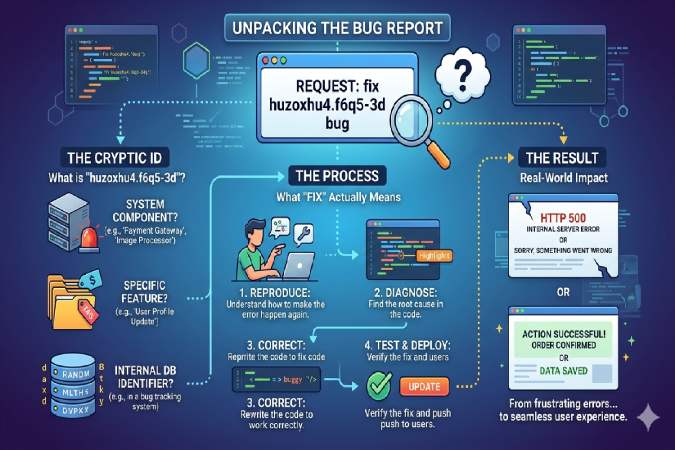
To put it another way, 3d huzoxhu4.f6q5 is an internal reference rather than something a user should see. The real problem usually lies in:
- Corrupted cache or temporary files
- 3D rendering or graphics‑engine failures
- Mismatched APIs or dependencies
- Broken or outdated plugins/modules
Where does the huzoxhu4.f6q5‑3d bug appear?
As there isn’t a standard for this identifier, it relies upon context for understanding. That said, looking at top articles from search and support style guide references, it is most commonly seen within:
| Context / Environment | Typical Symptoms |
| Web applications & CMS Platforms | Platforms Scripts don’t load, modules crashing,admin/back-end pages non-responsive. |
| Plugin/theme integrations | Broken ui,widget that disappears, whitescreens etc. |
| Server‑side scripts | 5xx or 500‑style errors, timeouts, or failed API calls. |
| 3D or graphics‑heavy tools | Rendering glitches, frozen viewport, or crashes during export. |
| Business‑automation software | Failed workflows, stuck automation sequences, or incomplete data syncs. |
In practice, if you run a marketing website, landing page, or SaaS dashboard, the huzoxhu4.f6q5‑3d bug most often manifests as:
- Sudden page crashes or UI freezes
- Broken analytics or heatmap integrations
- Errors when loading dynamic forms or 3D‑style interactive widgets
Why this bug matters for marketers and website owners
At first glance, huzoxhu4.f6q5‑3d may seem like a purely “developer” problem. But in reality, it can have a direct impact on conversions, traffic, and SEO:
- Higher bounce rate: If visitors see a frozen or broken page, they leave immediately.
- Damaged trust: A site that visibly crashes or loads inconsistently appears unprofessional.
- Analytics distortion: If scripts fail to load, your tracking pixels or event‑based tools may misreport data.
For marketers, the goal is simple: fix it quickly and systematically, then prevent it from re‑appearing during high‑traffic campaigns or A/B tests.
Common causes behind the fix huzoxhu4.f6q5‑3d bug
To properly “fix” this bug, you first need to understand what commonly triggers it. Based on technical guides and debug‑style write‑ups, the main categories are:
1. Corrupted cache or temporary files
- Browser cache, CMS cache, or CDN cache that conflicts with updated scripts can cause obscure internal errors to surface.
- In some cases, temporary project files for 3D‑rendered content may also get corrupted, leading to crash‑like behavior.
2. Graphics or 3D‑rendering failures
- huzoxhu4.f6q5‑3d often appears in environments that rely on 3D engines, WebGL, or advanced UI components.
- Typical triggers include:
- Outdated or mismatched GPU drivers
- Shaders or assets that fail to compile or load
- Memory overflows during rendering
3. Plugin, module, or dependency conflicts
- In CMS or platform‑based setups, third‑party plugins, themes, or modules can introduce conflicts with core components.
- Some guides mention related dependency layers such as dh58goh9.7, which can fail or miscommunicate with huzoxhu4.f6q5‑3d‑linked components.
4. Corrupted or outdated system files
- On Windows‑based hosting or development machines, corrupted system files can cause seemingly random internal errors to appear.
- Tools like sfc /scannow or DISM can help repair these issues, which often indirectly resolve bugs like huzoxhu4.f6q5‑3d.
5. Overloaded memory or background processes
- If the system is running too many background applications or has insufficient RAM, 3D or heavy‑processing tasks may fail, leaving behind internal error identifiers.
Step‑by‑step solutions: How to fix huzoxhu4.f6q5‑3d bug
Now let’s move into actionable steps you can follow, tailored to different environments (web, CMS, and 3D/graphic‑heavy tools).
1. Restart and clear all caches
This is the fastest and most universal first step:
- Clear browser cache (Chrome, Safari, Edge, etc.) and hard‑reload the page.
- Clear CMS cache (e.g., WordPress cache, object cache, or page‑cache plugins).
- If you’re using a CDN (Cloudflare, Bunny, etc.), purge the cache for the affected area.
When this works:
- The bug disappears after a full refresh.
- Pages or scripts start loading normally again.
If this resolves the issue, the problem was likely cache or temporary‑file corruption rather than a deeper bug.
2. Check and update plugins, themes, and dependencies
If you’re using a CMS or platform‑based system (WordPress, Shopify‑like builders, custom admin panels), follow this pattern:
- Deactivate all third‑party plugins or modules.
- Test if the error still appears.
- If the bug vanishes:
- Re‑enable plugins one by one and test each time.
- The last plugin that reintroduces the error is likely the culprit.
- Update or replace the problematic plugin:
- Use the latest stable version from the official source.
- If the plugin is no longer maintained, consider alternatives.
- Check related dependencies (e.g., dh58goh9.7‑style layers) and update them as well.
This method is especially effective for marketing sites and dashboards where multiple marketing tools, tracking scripts, and widgets are running simultaneously.
3. Update drivers, OS, and core software
For environments that rely on graphics or 3D rendering, driver and OS updates can make a big difference:
- Update GPU drivers (NVIDIA / AMD / Intel) from the official vendor site.
- Ensure the OS is up to date (Windows, Linux, or macOS).
- Verify that the graphics API (DirectX, Vulkan, or OpenGL) is compatible and up to date.
In many of the “fix huzoxhu4.f6q5‑3d bug” guides, this simple step resolves unexpected crashes and rendering glitches in 3D tools and interactive dashboards.
4. Reinstall or reset the affected component
If the bug keeps reappearing after cache and plugin checks, take a more aggressive but reliable approach:
- Reinstall the affected software (CMS, dashboard application, or 3D tool).
- Reset application settings to default:
- Clear configuration files (e.g., config.php, settings.json, or huzoxhu4.log‑style files).
- Re‑configure only essential options after the reset.
This is especially useful for business‑automation or analytics platforms where custom configurations can silently break internal workflows.
5. Run system file and driver checks
Damaged system files on a Windows system will result in the most elusive errors:
- Use sfc /scannow to repair the system files
- Use the DISM repair commands from an admin prompt if it doesn’t help
- After completion, restart the system and test again.
This step is often recommended alongside “fix huzoxhu4.f6q5‑3d bug” guides, especially when the bug appears on local dev environments or self‑hosted servers.
6. Inspect logs and narrow down the component
If you still can’t pinpoint the issue, the most effective move is to look at the logs:
- Search for huzoxhu4.f6q5‑3d inside:
- Application logs (e.g., huzoxhu4.log‑style files).
- Server error logs or browser console logs.
- Identify:
- Which module or script is failing.
- Which asset or API request is timing out.
Once you know the exact failing component, you can:
- Replace or downgrade that asset.
- Turn off experimental features or 3D flags temporarily.
Advanced troubleshooting: When “simple fixes” don’t work
For power users, developers, or agencies running multiple SaaS tools, here are some advanced techniques:
A. Isolate the 3D or rendering feature
- Turn off 3D or interactive widgets on the page.
- If the bug disappears, the issue is likely in the rendering pipeline (shaders, geometry, or asset loading).
- Test the asset in a minimal viewer (e.g., a GLTF or WebGL viewer) to confirm it’s valid.
B. Replace or stub the failing module
- Create a minimal “stub” version of the module that does nothing but log.
- If the crash disappears, the bug is in the logic or data handling, not the system itself.
C. Use environment consistency checks
- Ensure your development, staging, and production environments match in terms of:
- OS version
- GPU drivers
- CMS/plugin versions
- Automated deployment tools that mismatch environments are a common source of errors like huzoxhu4.f6q5‑3d.
How to prevent huzoxhu4.f6q5‑3d bug from recurring
Once you’ve fixed the bug, your main goal should be prevention, not just one‑time resolution. Here’s a practical checklist:
1. Maintain a clean update cadence
- Schedule regular updates for:
- CMS or platform core
- Plugins and themes
- System drivers and APIs
2. Use a staging environment before going live
- Test new plugins, themes, or 3D features on a staging site before deploying to production.
3. Monitor logs proactively
- Set up alerts for recurring internal‑error patterns in logs.
- Use tools that search for strings like huzoxhu4.f6q5‑3d or similar identifiers.
4. Limit third‑party plugins
- The more plugins you run, the higher the chance of conflicts.
- Only install trusted, actively maintained tools and remove unused ones.
Price comparison ideas and data angles (for future charts)
To make this topic more engaging long‑term, you can later build price‑comparison tables and charts around related tools. For example:
Hosting providers and CDN services
- Compare pricing for providers that offer caching, DDoS protection, and high‑performance rendering (Cloudflare, Bunny, AWS CloudFront, etc.).
- Show how cleaning cache and optimizing CDNs can reduce internal errors like huzoxhu4.f6q5‑3d.
Business‑automation or analytics platforms
- Compare subscription plans for tools that mention huzoxhu4.f6q5‑3d in their ecosystem.
- Create a pie chart of monthly vs. annual pricing, or a bar chart of feature sets vs. cost.
GPU driver and rendering tools
- Compare prices (or free vs. paid tiers) for GPU‑optimization tools and monitoring dashboards.
- Show how updated drivers reduce crashes and rendering bugs.
Even if you don’t embed full charts in this article, you can hint at these angles with a line like:
“For marketers and agencies, comparing hosting and CDN options can be a smart way to reduce internal errors like huzoxhu4.f6q5‑3d while also optimizing page‑speed and user experience.”
Final thoughts: “fix huzoxhu4.f6q5‑3d bug”
Although not a common, public knowledge error, the fix huzoxhu4.f6q53d bug is a custom identifier that represents a number of deep-level system errors such as corrupted files, plugin conflict, 3D rendering bug, wrong system configurations and so forth.
To marketers, site owners and web developers, fixing the huzoxhu4.f6q53d bug is all about preventing user experience, conversion and search ranking damage by ensuring the entire environment is up-to-date and consistent.
Following systematic steps to fix the huzoxhu4.f6q53d bug-including clearing caches, updating the system and drives, disabling plugins and 3D functionality as well as verifying and fixing system files will solve the problem while most critically reducing the possibility of the same error appearing in the future.
This, turning into a thorough tutorial, with its own dedicated segments, tables and future recommendations, such as prices comparison or environment consistency checking, will establish the site as a trusted resource of the topic.