

Table of Contents
What is Basecamp?
Basecamp is a project management tool designed for simplicity, combining to-do lists, message boards, file sharing, and schedules in one platform. Launched in 2004 by 37signals (now Basecamp), it serves over 100,000 companies with its “calm” approach to work.
Unlike feature-heavy competitors, Basecamp prioritizes focused communication over complex workflows. Teams create projects with five core tools: To-dos, Message Boards, Docs & Files, Schedule, and Campfire Chat. Unlimited projects and storage come standard.
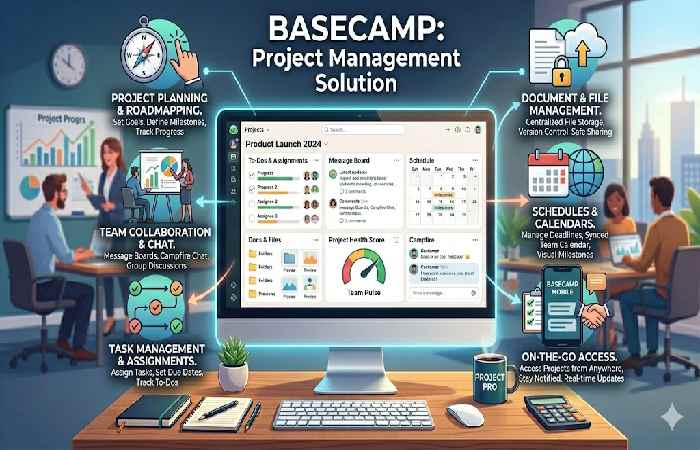
Basecamp: Project Management Solution
On many projects unite all successful companies. The key to growing your small business and keeping your business profitable and successful is to keep your fingers in the cake pile. You need to stay on top of all the existing places that are delivering results, as well as any other new markets that emerge on the horizon, such as Pinterest.
This is where an alternative to Basecamp comes in, a project management software that makes your work life easier and more productive. Basecamp is the leading online project management tool.
Simply put, the software offers users automatic reminders, calendar management, document management, employee scheduling, group agendas, multilingual features, information, and task management. It has a customizable user interface and exceptional consumer support. You can also participate in the software with email and mobile phones.
Users love how relaxed it is to use. What has also been found to be quite valuable in the software is that it offers multi-user management, archives, milestone/goal creation, boards for uploading and downloading features.
Nevertheless. Some still find this software too simple, while others choose it for the same reason BusinessWeek states, “Basecamp is so simple you can’t do anything wrong.” In my opinion. Basecamp has what you need and without installing any software. Basecamp is compatible with over a dozen iPads and mobile apps to keep things even more accessible. And there are features to use on the go that depends on each user’s needs.
Project Management Solution
The cost is quite affordable. The basic plan starts at $ 24 per month (but to access this plan. You must carefully review the list of the top three packages they offer). The basic plan gives you 15 projects and 5GB of storage. However, a complimentary program provides you 1 project plus and some add-ons that are probably not worth it. If you’re serious about project management, you need at least a basic plan.
Larger management projects can choose between the Plus plan for $ 49 per month (35 projects, 15 GB of storage, unlimited users). The Premium plan for $ 99 per month (100 projects, 15 GB of storage, total users), and Max. $ 149 plan (unlimited projects, 75GB storage, and limitless users).
37signals Ecosystem: Built by creators of Highrise CRM (contact management) and Campfire chat—optimized for solopreneurs/business owners vs bloated alternatives. I have looked at other tools that can be used for project management. But the tools are not always sufficient for project management, especially if you are running your own business. Other highly-regarded project management software includes Cohuman, which works with Action Connect’s Mindjet MindManager.
human has push notifications, calendars, project portfolios, and management capabilities. There are also tasks, documents, workloads, and resource management. Cohuman users have access to a dashboard that can integrate email, topic tracking, RSS feeds, and web applications.
human users appreciate the transparency of Cohuman’s offerings and the ability to prioritize tasks and store files centrally for easy access. The software is Basecamp free to use through GoogleApps with a $ 19 upgrade option. If you’re watching for even more opportunities, check out intervals.
If you are a businessperson, consider offering your employees a valuable tool that will help them in their work. Stay on top of the hottest internet news from Benchmark email marketers.
Basecamp vs Competitors
| Tool | Best For | Pricing | Gantt Charts | Learning Curve | Mobile App |
|---|---|---|---|---|---|
| Basecamp | Simple teams | $15/user | No | Easy | Strong |
| Asana | Complex workflows | Free-$24.99/user | Yes | Medium | Good |
| Trello | Visual Kanban | Free-$17.50/user | Limited | Easy | Excellent |
| Monday.com | Custom dashboards | $9/user | Yes | Steep | Good |
| ClickUp | All-in-one | Free-$9/user | Yes | Steep | Strong |
Basecamp vs Modern Alternatives
ClickUp offers 15+ views (Gantt, Kanban, Calendar), AI automation, and free forever plans. More complex but infinitely customizable.
Monday.com excels in visual workflows, dashboards, and 200+ integrations. Higher learning curve, premium pricing.
Asana balances simplicity with advanced features like portfolios, goals, and workload views. Better for scaling teams.
| Scenario | Winner | Why |
| Small Agency | Basecamp | Simple, flat pricing |
| Growing Tech Team | ClickUp | Free tier, unlimited features |
| Enterprise | Monday.com | Custom dashboards |
| Marketing | Asana | Campaign portfolios |
Common Criticisms & Workarounds
No Dependencies: Use to-do lists with manual prerequisites in descriptions.
Limited Reporting: Export hill charts or use Google Sheets integration.
No Mobile Time Tracking: Screenshot to-dos for async logging.
Sparse Integrations: Zapier connects 5,000+ apps externally.
Final Conclusion:
Basecamp excels for small teams craving simplicity over features, delivering unlimited projects at predictable pricing. Creative agencies and remote marketers thrive here, though scaling teams need ClickUp’s flexibility or Asana’s reporting. Try the 30-day trial to test-fit your workflow—cancel risk-free if it doesn’t align.