

In the current competitive market, it is no longer a matter of choice to know your customers, it has become a survival factor. Database marketing is no longer a simple mailing list but now is a complex, data-driven strategy used to drive personalized customer experience on a large scale.
It is a complete guide to database marketing, covering all the basics to the more sophisticated implementation strategies that lead to quantifiable business outcomes.
Table of Contents
What is Database Marketing?
Database marketing is a programmed way of gathering, interpolating and using customer information to develop specified, individualistic marketing campaigns. It applies central databases of customers to recognize certain audiences and send them appropriate messages that lead to engagement, conversions, and commitment.
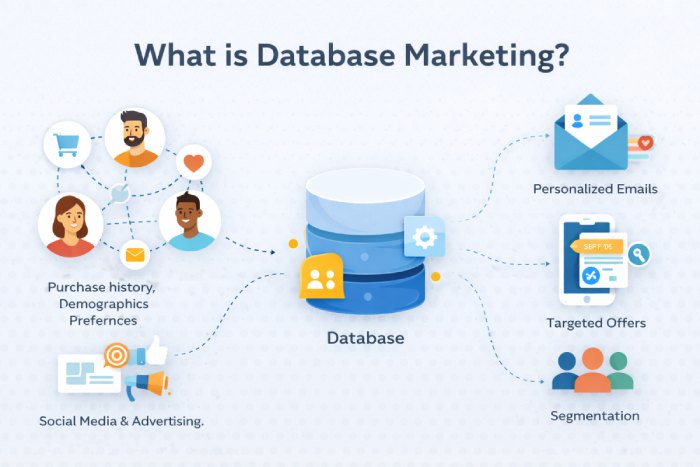
Simple Definition
Imagine database marketing to be the development of a comprehensive profile of each of the customers and then using the information to deliver to them precisely what they desire when they desire it.
Database marketing will allow you to send the same message to everybody (traditional mass marketing):
- Deliver customized product suggestions by purchase history.
- Target individual customers with personalized deals.
- Revive dormant clients using incentives.
- When the customer wants it, anticipate it.
Example: Database marketing is used by an online bookstore to monitor the kind of genres that each customer likes. As a new thriller book is being published they automatically send focused emails only to people who have already bought thrillers but not to other people- this will lead to 5x better conversion than the general promotions.
How Database Marketing Works
Database marketing functions in a cyclic manner:
- Gather customer information in a variety of touchpoints (website, purchases, emails, social media)
- Keep data of the stores in a database or customer data platform.
- Interpret statistics to get patterns, segments, and opportunities.
- Segment the target customers into individual campaigns.
- Quantify the outcomes of measurements and optimize performance.
It is the strength of the feedback loop – any campaign creates new data which further enhances the campaigns themselves.
Evolution from Direct Mail to Digital
Database marketing isn’t new—it’s evolved dramatically over decades:
1980s-1990s: Direct Mail Era
- Companies maintained lists of addresses
- Sent catalogs and promotional mailers
- Limited segmentation (usually just geography)
- Response rates tracked manually
2000s: Digital Transition
- Email replaced direct mail
- CRM systems emerged
- Basic demographic segmentation
- Online behavior tracking began
2010s: Big Data Revolution
- Multiple data sources integrated
- Advanced segmentation and personalization
- Marketing automation platforms
- Predictive analytics introduced
2020s-Present: AI-Powered Intelligence
- Real-time personalization
- Predictive customer modeling
- Privacy-first data collection
- Omnichannel orchestration
- AI-generated content and recommendations
Today’s database marketing leverages technologies that weren’t imaginable 20 years ago, making it more powerful—and more complex—than ever.
Database Marketing vs. CRM: Understanding the Difference
The terms “database marketing” and “CRM” are often confused. While related, they serve different purposes.
Key Distinctions
| Aspect | Database Marketing | CRM (Customer Relationship Management) |
| Primary Purpose | Marketing campaign execution | Relationship management across all touchpoints |
| Focus | Outbound marketing to segments | Inbound and outbound customer interactions |
| User Base | Marketing teams | Sales, service, and marketing teams |
| Functionality | Segmentation, targeting, campaign management | Contact management, sales pipeline, customer service |
| Approach | Proactive (push messaging) | Reactive and proactive (responding + initiating) |
| Data Usage | Analyze and target customer segments | Track individual customer journey and history |
How They Work Together
Database marketing and CRM are complementary:
CRM provides the data foundation:
- Stores customer contact information
- Tracks interaction history
- Records purchase data
- Manages customer service tickets
Database marketing leverages that data:
- Segments customers based on CRM data
- Creates targeted campaigns
- Personalizes messaging
- Measures campaign effectiveness
Example workflow:
- CRM tracks that Customer A purchased Product X
- Database marketing creates a segment of “Product X buyers”
- When Product Y (complementary to X) launches, database marketing automatically targets this segment
- Purchase is recorded back in CRM
- Customer service team sees full history when Customer A calls
When to Use Each
Use CRM when you need to:
- Manage sales pipelines
- Track customer service interactions
- View individual customer histories
- Coordinate across departments
Use database marketing when you need to:
- Execute targeted email campaigns
- Segment customers for specific promotions
- Automate marketing workflows
- Analyze campaign performance
Best practice: Integrate both systems so data flows seamlessly between relationship management and marketing execution.
Types of Database Marketing
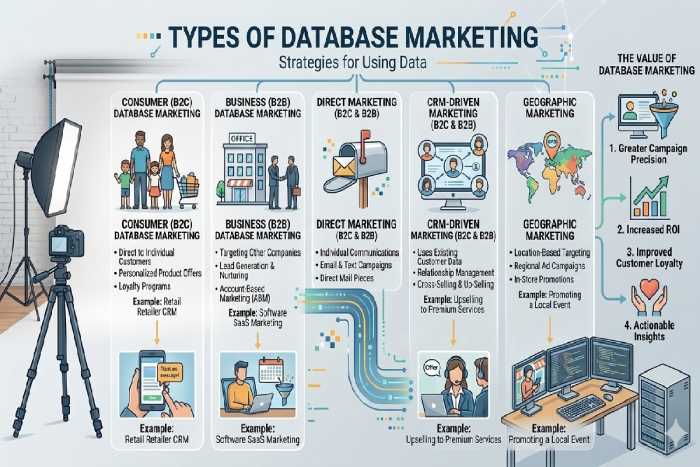
Database marketing strategies differ significantly between business-to-consumer (B2C) and business-to-business (B2B) contexts.
B2C Database Marketing
Characteristics:
- Large customer databases (thousands to millions)
- Shorter sales cycles
- Individual consumer decision-making
- Emphasis on emotional triggers
- High-volume, automated campaigns
Common data points:
- Demographic: Age, gender, location, income level
- Purchase history: Products bought, frequency, average order value
- Behavioral: Website browsing, email engagement, app usage
- Preferences: Communication channels, product interests
- Lifecycle stage: New customer, repeat buyer, at-risk, churned
Typical use cases:
- Abandoned cart recovery emails
- Personalized product recommendations
- Birthday and anniversary offers
- Loyalty program communications
- Win-back campaigns for inactive customers
Example: An e-commerce fashion retailer segments customers by:
- Gender and size preferences
- Style affinity (casual, formal, athletic)
- Price sensitivity (budget, mid-range, luxury)
- Purchase frequency (seasonal vs. year-round shoppers)
Each segment receives tailored emails showcasing relevant products at appropriate price points.
B2B Database Marketing
Characteristics:
- Smaller databases (hundreds to thousands of companies)
- Longer, complex sales cycles
- Committee-based decision-making
- Focus on rational business value
- Multi-touch nurturing campaigns
Common data points:
- Firmographic: Company size, industry, revenue, location
- Technographic: Technologies used, software stack
- Engagement: Content downloads, webinar attendance, demo requests
- Intent signals: Website behavior, topic interests
- Relationship: Decision-maker roles, buying committee structure
Typical use cases:
- Lead nurturing workflows
- Account-based marketing campaigns
- Event follow-up sequences
- Content personalization by industry
- Sales enablement for specific accounts
Example: A B2B SaaS company segments prospects by:
- Company size (SMB, mid-market, enterprise)
- Industry vertical (healthcare, finance, retail)
- Engagement level (cold, warm, hot)
- Decision stage (awareness, consideration, decision)
Each segment receives different content—SMBs get self-service resources, while enterprises receive personalized consultations.
Comparison Table
| Factor | B2C | B2B |
| Database Size | 10,000-10,000,000+ | 100-100,000 |
| Sales Cycle | Minutes to days | Weeks to months |
| Decision Maker | Individual consumer | Buying committee |
| Average Deal Size | 500 | 500,000+ |
| Campaign Volume | High frequency, automated | Lower frequency, personalized |
| Key Metric | Conversion rate, CLV | Pipeline influence, deal velocity |
| Personalization | Product-based | Role and industry-based |
How Database Marketing Works: The Complete Process
Successful database marketing follows a systematic six-step process.
1: Data Collection
Sources of customer data:
First-party data (collected directly):
- Website forms and registrations
- Purchase transactions
- Email and SMS opt-ins
- Customer service interactions
- Loyalty program participation
- Mobile app usage
- Survey responses
Second-party data (from partners):
- Co-marketing partnerships
- Affiliate networks
- Data-sharing agreements
Third-party data (purchased):
- Data brokers and aggregators
- Market research firms
- Public records
Best practice: Prioritize first-party data for accuracy and compliance. Third-party data quality has declined significantly due to privacy regulations.
2: Data Organization and Storage
Database structure options:
Relational databases:
- Structured tables with defined relationships
- Best for transactional data
- Examples: MySQL, PostgreSQL, Microsoft SQL Server
Customer Data Platforms (CDP):
- Unified customer profiles across touchpoints
- Real-time data synchronization
- Examples: Segment, Treasure Data, Salesforce CDP
Data warehouses:
- Large-scale analytical storage
- Historical data for deep analysis
- Examples: Snowflake, Google BigQuery, Amazon Redshift
Key considerations:
- Scalability (can it grow with your business?)
- Integration capabilities (connects to existing tools?)
- Data governance (access controls and security)
- Compliance features (GDPR, CCPA support)
3: Customer Segmentation
Segmentation approaches:
Demographic segmentation:
- Age, gender, income, education
- Geographic location
- Family status
Behavioral segmentation:
- Purchase frequency and recency
- Product preferences
- Channel preferences (email, SMS, social)
- Engagement level
Psychographic segmentation:
- Lifestyle and values
- Interests and hobbies
- Attitudes and opinions
RFM analysis (powerful for e-commerce):
- Recency: When did they last purchase?
- Frequency: How often do they buy?
- Monetary: How much do they spend?
4: Campaign Development
Campaign planning includes:
Define objectives:
- What do you want to achieve? (sales, engagement, retention)
- Which segment(s) will you target?
- What’s the desired action?
Create messaging:
- Personalize subject lines and content
- Match tone to segment characteristics
- Develop compelling calls-to-action
Choose channels:
- Email (highest ROI for most businesses)
- SMS (time-sensitive offers)
- Direct mail (high-value segments)
- Push notifications (mobile app users)
- Social media (retargeting)
Design creative assets:
- Email templates
- Landing pages
- Promotional graphics
- Product imagery
5: Execution and Personalization
Personalization tactics:
Basic personalization:
- Name insertion in subject line and body
- Location-based offers
- Gender-specific product recommendations
Advanced personalization:
- Dynamic content blocks based on preferences
- Product recommendations from purchase history
- Send-time optimization (email arrives when user typically engages)
- Predictive content (AI-driven suggestions)
Marketing automation triggers:
- Welcome series for new subscribers
- Abandoned cart recovery (typically 3 emails over 7 days)
- Post-purchase follow-up
- Re-engagement for inactive users
- Birthday and anniversary messages
Benefits of Database Marketing
Improved Personalization
Database marketing enables personalization at scale—delivering relevant messages to thousands or millions of customers simultaneously.
Impact:
- 3-5x higher email open rates for personalized subject lines
- 6x higher transaction rates for targeted emails
- 20% increase in sales from personalized recommendations
Higher ROI and Conversion Rates
Targeted campaigns outperform generic broadcasts dramatically.
Industry benchmarks:
- Segmented email campaigns achieve 14.31% higher open rates and 100.95% higher click rates than non-segmented campaigns (Mailchimp data)
- Personalized emails deliver 6x higher transaction rates
- Database marketing ROI averages 1 spent (DMA research)
Why it works: You’re reaching people who’ve already expressed interest, with offers relevant to their needs, at times they’re likely to engage.
Better Customer Retention
Acquiring new customers costs 5-25x more than retaining existing ones. Database marketing focuses resources on your most valuable asset—current customers.
Retention tactics:
- Loyalty program communications
- Exclusive offers for repeat customers
- Win-back campaigns for at-risk customers
- Personalized re-engagement
Example: Amazon Prime uses database marketing to analyze purchase patterns and send targeted “subscribe and save” recommendations, increasing repeat purchase frequency by 30%+.
Enhanced Customer Lifetime Value
By understanding customer behavior, you can:
- Recommend complementary products (cross-selling)
- Suggest premium alternatives (upselling)
- Time offers when customers are ready to buy again
- Prevent churn before it happens
CLV impact: Companies using advanced database marketing see 20-30% higher CLV compared to those using basic segmentation.
Cost Efficiency
Database marketing reduces waste by targeting only receptive audiences.
Cost savings:
- Lower email costs (send only to engaged subscribers)
- Reduced ad spend (target lookalike audiences)
- Fewer printed materials (precision direct mail)
- Higher conversion rates mean lower CAC
Example: Instead of mailing 100,000 catalogs at 200,000), a retailer uses database marketing to identify the 20,000 most likely buyers, sending only to them
Data-Driven Decision Making
Database marketing replaces guesswork with evidence.
Strategic insights:
- Which products have the highest repurchase rates?
- What customer segments are most profitable?
- Which acquisition channels deliver the best CLV?
- When are customers most likely to churn?
- What messaging resonates with each segment?
This intelligence informs not just marketing, but product development, pricing, and business strategy.
Database Marketing Strategies That Work
Lifecycle segmentation:
- New customers (onboarding focus)
- Active customers (retention and upsell)
- At-risk customers (win-back efforts)
- Churned customers (reactivation or suppression)
Engagement segmentation:
- Highly engaged (frequent openers/clickers)
- Moderately engaged (occasional interaction)
- Disengaged (no recent interaction)
- Never engaged (consider removal)
Value-based segmentation:
- VIPs (top 10% by revenue)
- High-value customers
- Average-value customers
- Low-value customers
Predictive segmentation:
- Likely to purchase next 30 days
- High churn risk
- Responsive to discounts
- Brand advocates (likely to refer)
Personalization Tactics
Dynamic content blocks:
- Show different products based on browsing history
- Adjust messaging by lifecycle stage
- Display location-specific store information
- Customize imagery by demographic preferences
Behavioral triggers:
- Browse abandonment (viewed but didn’t add to cart)
- Cart abandonment (added but didn’t purchase)
- Post-purchase cross-sell (bought X, might want Y)
- Replenishment reminders (time to reorder?)
Predictive recommendations:
- “Customers like you also bought…”
- “Based on your purchase history…”
- “You might be interested in…”
Re-engagement Campaigns
Win-back inactive customers:
Tiered approach:
- 30 days inactive: “We miss you” email with personalized recommendations
- 60 days inactive: Special offer or incentive (15% off next purchase)
- 90 days inactive: Last-chance campaign or feedback survey
- 120+ days inactive: Sunset (remove from active list to improve deliverability)
Effective tactics:
- Remind them what they’re missing (new products, features)
- Offer exclusive “come back” discount
- Ask for feedback (why did they disengage?)
- Showcase social proof (testimonials, reviews)
Cross-Selling and Upselling
Cross-selling: Recommend complementary products Upselling: Suggest premium alternatives
Effective approaches:
Post-purchase cross-sell:
- Bought camera → Recommend lenses, memory cards, camera bag
- Bought book → Suggest author’s other titles
- Bought software → Promote training courses
Pre-purchase upsell:
- Shopping for basic plan → Highlight premium benefits
- Browsing standard product → Show upgraded version
- About to checkout → “Frequently bought together” bundle
Timing matters: Post-purchase cross-sells perform best 7-14 days after delivery when customer is using and enjoying the product.
Lifecycle Marketing
Map campaigns to customer journey:
Awareness stage:
- Educational content
- Brand introduction
- Problem identification
Consideration stage:
- Product comparisons
- Case studies
- Free trials or demos
Purchase stage:
- Time-limited offers
- Social proof
- Simplify decision-making
Retention stage:
- Onboarding sequences
- Usage tips and best practices
- Customer success stories
Advocacy stage:
- Referral programs
- Review requests
- VIP perks
Predictive Marketing
Use historical data to predict future behavior:
Churn prediction:
- Identify signals that precede cancellation
- Proactively reach out with retention offers
- Reduce churn by 15-25%
Next-best-action:
- What should we offer this customer next?
- When should we contact them?
- Through which channel?
Propensity modeling:
- Likelihood to purchase
- Lifetime value prediction
- Response probability
Real-World Database Marketing Examples
Amazon’s Recommendation Engine
Strategy: Analyze browsing and purchase history to suggest relevant products.
How it works:
- Tracks every product view, search, and purchase
- Uses collaborative filtering (“customers who bought X also bought Y”)
- Personalizes homepage, search results, and email recommendations
- Tests different recommendation algorithms continuously
Results:
- 35% of Amazon’s revenue comes from recommendations
- Significantly higher conversion rates than non-personalized product displays
Netflix Personalization
Strategy: Use viewing history to personalize content recommendations and artwork.
How it works:
- Tracks every show watched, paused, rewound, or abandoned
- Segments users into over 2,000 “taste communities”
- Personalizes not just recommendations but also thumbnail images (action fans see action-packed imagery; drama fans see emotional scenes)
- A/B tests everything continuously
Results:
- 80% of viewing comes from recommendations
- Reduced churn by keeping users engaged with relevant content
Retail Loyalty Programs
Strategy: Sephora’s Beauty Insider program uses purchase data to personalize offers.
How it works:
- Tracks every purchase (product, brand, price point)
- Segments by beauty preferences (skincare, makeup, fragrance)
- Sends personalized product recommendations
- Offers birthday gifts based on preferences
- Provides tier-based rewards (increasing with spending)
Results:
- Beauty Insider members account for 80% of Sephora’s annual sales
- Members spend 15x more than non-members
B2B Lead Nurturing
Strategy: HubSpot uses database marketing to nurture leads through long B2B sales cycles.
How it works:
- Captures lead information through content downloads
- Segments by industry, company size, and engagement level
- Delivers educational content matched to buyer journey stage
- Scores leads based on engagement and demographic fit
- Automatically alerts sales when leads become “sales-ready”
Results:
- 50% more sales-ready leads at 33% lower cost
- Shortened sales cycle by providing relevant information at each stage
Essential Database Marketing Tools and Software
CRM Platforms
Purpose: Central repository for customer data and relationships
Top options:
Salesforce:
- Industry leader, highly customizable
- Best for: Enterprise companies, complex sales processes
- Price: 300+ per user/month
HubSpot CRM:
- Free tier available, intuitive interface
- Best for: SMBs, marketing-sales alignment
- Price: Free-$1,200+ per month
Zoho CRM:
- Affordable, extensive features
- Best for: Budget-conscious businesses
- Price: 52 per user/month
Microsoft Dynamics 365:
- Deep Office 365 integration
- Best for: Microsoft-centric companies
- Price: 210 per user/month
Conclusion:
Database marketing is also a form of targeted direct marketing but it involves the use of organized and centralized databases of the customer demographics, purchase history and behavioral data to design very specific marketing campaigns. It helps businesses optimize ROI, enhance customer retention, and loyalty through sending personalized messages through email, SMS, or social media to individual.