
Zomhom Site is usually searched by people who want to understand what the website is, whether it is real, and whether its claims can be trusted. Based on available search results, the site has been discussed in connection with free recharge, SIM conversion, and other promotional claims, but several independent sources raise concerns about transparency and reliability.
That means the dominant intent is informational, with a strong safety-and-verification angle. Users are not just asking what the site does; they are asking whether it is legitimate and safe enough to use. This article answers that directly and gives you a practical framework for checking any similar site.
Table of Contents
What Zomhom site appears to be
Search data suggests zomhom.site is a WordPress-based website with content that has been described as covering education, social, technology, crypto, apps, and similar information. Other results describe it as a site tied to claims such as free mobile recharge, password retrieval, or SIM conversion offers.
That combination is important because it makes the site hard to categorize cleanly. It does not appear to behave like a standard branded service website with clear ownership, service terms, and business identity. Instead, it seems to have attracted attention mainly because of the offers it promotes and the questions those offers raise.
Why do people search for it?
People usually search for sites like this for one of three reasons:
- They saw a claim about a free recharge or a similar offer.
- They want to know whether the website is real or fake.
- They are trying to avoid scams or risky websites.
That is a valid concern. Sites that promise unusually attractive benefits, especially without clear support details, often deserve extra scrutiny. The more a page promises and the less it explains, the more careful a user should be.
Key trust signals to check
If you are evaluating zomhom.site or any similar domain, look for the basics first. These are the most important trust signals:
- Clear ownership information.
- A visible company or contact address.
- Straightforward terms and conditions.
- Working support channels.
- Consistent branding across the site.
- Real explanations of what the service actually does.
A lack of these details is a red flag. One review of the site specifically notes concerns like redirect behavior, poor transparency, no disclosed owner, and no clear support structure. Another trust-check source rates a closely related domain very low and warns that it may be a scam.
Common red flags
Some warning signs show up often in questionable websites. In the available sources, several of these concerns are mentioned directly:
| Red flag | Why it matters |
| No owner identity | Makes accountability difficult |
| Redirects to other sites | Can indicate deceptive behavior |
| Weak or fake-looking content | Suggests the page may not be reliable |
| No address or legal support | Makes dispute resolution hard |
| Low trust score | Indicates risk based on site analysis |
These issues do not automatically prove a site is harmful, but they do mean you should proceed cautiously. If a website is vague about who runs it and how it works, that is usually enough reason to slow down.
What the traffic data suggests
Some traffic tools show that zomhom.site has received notable visits and search-driven traffic, especially from Google organic search. That does not mean the site is trustworthy; it only means the site has visibility and attention.
This is an important distinction. High traffic can come from curiosity, trending claims, or misleading headlines just as easily as it can come from genuine usefulness. A website can be popular and still be unsafe or poorly transparent.
Is it safe to use
From the available evidence, caution is the best answer. Multiple sources raise concerns about legitimacy, unclear ownership, and unverified claims. That means users should avoid entering personal data, login credentials, or payment details unless the site is clearly verified.
A safe decision process would look like this:
- Check the exact domain.
- Read the full site, not just the headline offer.
- Look for business identity and contact information.
- Search for independent reviews.
- Avoid giving sensitive information unless trust is established.
If a site is asking for personal details in exchange for a promise that sounds too good to be true, that is a strong reason to stop.
How to compare it with alternatives
When a site claims to offer free services or special conversions, compare it with more established sources first. Ask whether the same thing is available through official telecom providers, app stores, or recognized service platforms.
| Option type | Reliability | Best use |
| Official provider | High | Account, service, and billing issues |
| Established app/platform | Medium to high | Tools and utilities |
| Unknown promotional site | Low to uncertain | Only with careful verification |
This approach is especially useful for recharge-related claims and technical service claims like SIM conversion or password recovery. In those areas, official providers are usually the safest option.
Practical advice for users
If you encountered zomhom site through search or social media, keep these rules in mind:
- Do not share OTPs, passwords, or payment details.
- Do not assume a “free” claim is genuine.
- Verify through independent sources before clicking deep links.
- Avoid downloading files from unfamiliar pages.
- Close the page if it asks for sensitive data without a clear reason.
The goal is not panic. The goal is informed caution. That is the best way to protect yourself when a site’s claims are exciting but its credibility is unclear.
How Does the Zomhom Site Actually Work?
Let me walk you through what happens when someone visits the Zomhom Site:
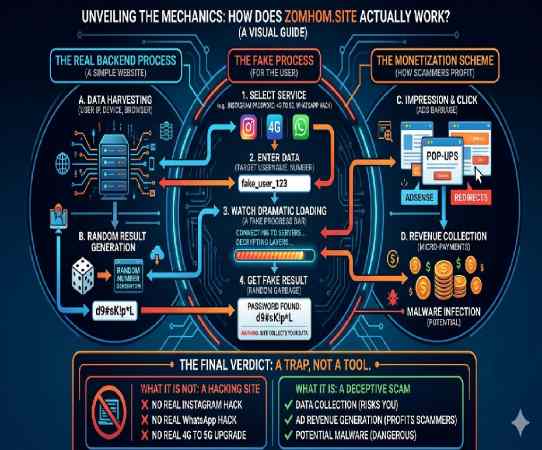
Step 1: The Bait
You land on the homepage promising services like:
- Zomhom Site 2024 Instagram Password Cracking
- Zomhom Site WhatsApp message access
- Zomhom साइट WhatsApp (Hindi version targeting Indian users)
- Zomhom Site Call History tracking
- Zomhom Site Location Finder
- Zomhom Site WiFi Password Cracker
Step 2: The Fake Process
You enter a username (let’s say an Instagram handle). The site displays a fancy loading animation with text like “Connecting to servers…” or “Breaking encryption layers…”
Step 3: The Bogus Result
After 30-60 seconds of theatrical loading, Zomhom spits out a random password or fake data. People get excited thinking it worked—until they actually try using the “password” and realize it’s nonsense.
Step 4: The Real Goal
While you’re distracted, the site might:
- Collect your IP address and device information
- Show you misleading ads (they make money from clicks)
- Redirect you to phishing pages
- Convince you to download malware-infected apps
Popular Zomhom Site Features
| Feature Name | What It Claims | Reality |
| Zomhom Instagram Password | Reveals any Instagram account password | Generates random characters |
| Zomhom Site Instagram Private Account | Shows private account posts | Displays placeholder images |
| Zomhom Site 4g to 5g | Upgrades your phone network | Technically impossible through a website |
| Zomhom Site WiFi Password | Cracks nearby WiFi passwords | Shows random alphanumeric strings |
| Zomhom Site Phonepe | Claims to hack PhonePe wallets | Completely fabricated “balances” |
| Zomhom Site 5g | Promises 5G speed boosts | Pure fiction |
| Zomhom App | Downloadable hacking tool | Often contains adware or malware |
FAQ Section
What is the Zomhom site?
It appears to be a WordPress-based website that has been discussed in connection with various online claims and informational content.
Is the Zomhom site legit?
Available sources raise trust concerns, so it should be treated cautiously rather than assumed to be legitimate.
Why does the Zomhom site get traffic?
Some traffic appears to come from search interest and curiosity around its claims.
Should I enter personal details on the Zomhom site?
Not unless the site’s ownership, purpose, and trust signals are clearly verified.
Conclusion
The available evidence suggests that the Zomhom site should be approached with caution because of unclear identity, questionable claims, and trust concerns reported by multiple sources. The safest conclusion is to verify carefully and avoid sharing sensitive information unless the site becomes clearly trustworthy.